Genre bliss
I don't know who's behind Electric Storytime (the site provides no clues) but I love these short send-ups of literary fiction. For the cocktail lounge regret scene, try "A Time to Meow."
I don't know who's behind Electric Storytime (the site provides no clues) but I love these short send-ups of literary fiction. For the cocktail lounge regret scene, try "A Time to Meow."
My previous post hinted at the possible advantages of writing in a positive rather than negative vein.
But sometimes negative is the only way to go. And no one can sound more positive when he's being negative than Chicago Sun-Times tech columnist Andy Ihnatko. Watch a master in action as he vaporizes the Zune.
The late Stephanie Feeney, founder of the Northwest Gardeners' Resource Directory, was a superb writer and public speaker. I remember hearing her talk about English gardens at the Northwest Garden Show at a time when I was considering writing a travel guide to mystery locales. I noticed immediately that Stephanie managed to be colorful, amusing, and distinctive without ever falling back on two very common communications crutches: deprecation and self deprecation.
Anyone who's made a living writing criticism knows how much more attention accrues to a clever, withering attack on a book or film than to an equally well-crafted paean. Complaints and criticism, at least when initially (and creatively) expressed, can be highly entertaining.
And yet, over time, that attention-getting negative approach can come back to hurt a writer. Gradually, the reader comes to think of the writer, the column, or the blog as one long whine, rant, or pity fest.
This danger, I think, is particularly true when writing "how-to" pieces or advice. The writer who focuses advice on what to avoid and how to spot signs that you are screwing up runs the risk of coming across as a sanctimonious finger-waggler. Unless you know the author well, or she is addressing your specific situation, it can be very easy to decide the last thing you want to read is, well, an unsolicited lecture or a dose of negativity.
In September, marketing guru Daphne Gray-Grant wrote a piece for Marketingprofs.com on "Five Negative Thoughts That Can Sabotage Your Writing (and How to Shake Them)." This month she followed up with "Five Positive Thoughts That Will Turbocharge Your Writing (and How to Channel Them)."
Both articles are packed with good information. I'd be curious to hear your reactions to the titles, and to the pieces themselves. Which one did you want to read most? Did you enjoy reading one more than the other?
Deborah Ng of Writers Row, who compiles an excellent listing of freelance writing jobs and has been a perennial resource for the online writing community, passed along the blogging meme "Five things you didn't know about me."
I've adapted it to be "Five things you didn't know about my writing career."
1. I got my start in writing penning consumer complaint letters for my mother after our vacuum cleaner blew up.
2. My first short story was "The Christmas Tree and the Hanukkah Bush."
3. My first paid, published writing gig was music criticism for the New Haven Advocate. One of my pieces was a profile of a hard-working local rock singer who'd spent more than a decade trying to break into the big time but was getting discouraged by increasing violence on the concert circuit. A few years later, he finally hit it big (Michael Bolton).
4. My journalism thesis at Columbia was about court battles involving the drug paraphernalia industry. While working on the thesis, I met and dated a charming NYC civil liberties attorney whose clients included NORML and Dial-a-Joint. Our dates frequently included swinging by night court for arraignments.
5. I spent more than a year in the early 1980s working on two interrelated investigative stories involving illegal garbage dumping, corrupt local officials, and a lot of people with Italian last names. By the time it was over, I'd been chased by a garbage truck, had worn a wire while conducting an interview, and a landfill (seized by the FBI) had caught fire. Repercussions from the story went on for years, culminating in a landfill worker we'd exposed for illegal overtime taking a town official hostage. Fortunately, the official escaped by climbing out a bathroom window.
Please try this meme yourself! And let me know when you've posted it.
Yesterday's New York Times had a mindboggling article about a New York area fitness club that revoked a man's membership because he was making a grunting sound while lifting weights. He was bench pressing 500 pounds at the time, bless his soul.
If this were the independent action of a particularly fussy club manager, it would be one thing, but the "grunt-and-you're-out" rule is a policy of the club's parent chain, Planet Fitness -- a company whose management would, indeed, seem to be from outer space.
This article caught my interest because I'm currently doing a "trailer park" yoga program four days a week. It mixes yoga with weightlifting, jumping rope, running stairs, working with wrist and ankle weights, and working with heavier weights, including 15-pound handweights and a weight bench. I haven't heard anyone in our group of two dozen women grunt, per se, but I have heard plenty of moaning, shrieking, and screaming. And maybe a howl or two. The teacher, who is the most inspiring fitness instructor I've ever encountered, encourages the sound effects.
I tend to shriek, myself. Fifty leg lifts hurt.
According to the Times article, the club's no-grunt rule (and a few other weird ones, as well) has nothing to do with cutting down on distracting noise in the gym. It's based on the chain's philosophy that most members are intimidated and discouraged by body builders and other serious fitness types. The club therefore has crafted rules that discourage those fitniks from patronizing the gym and disturbing the place with sounds of physical effort.
Oh, heaven forbid anyone should connect hard work, physical or mental, with achievement. Americans are fervent believers in overnight weight loss, cosmetic surgery, and unregulated herbal potions. Hard work and discipline? Argggh! Fortunately Planet Fitness is here to protect us from the sight -- and sound -- of it.

While podcasting leaves me cold, I'm increasingly enthusiastic about photoblogging. Doug Plummer's Daily photo can be breathtaking, and I'm a big fan of New York's The Sartorialist. If you have time, the extensive reader comments at The Sartorialist can be as entertaining as the photos themselves. (So few blogs have really good comments that this success is worth some analysis.)
Seattle now has its own version of The Sartorialist, Pike/Pine, which, despite its name, has recently focused on Ballard -- and on fashion worn by 20-somethings. Yawn. Nice photography, but let's have some context here...fashion wasn't invented 10 years ago. Even Seattle knew about it before then. Let's see some of the older fashionistas who frequent Nordstrom designer shoes downtown.
Finally, you don't have to be a photo pro to make great use of pix to spice up a blog. Guy Kawasaki's blog uses small photos, often stock, usually to very good effect.
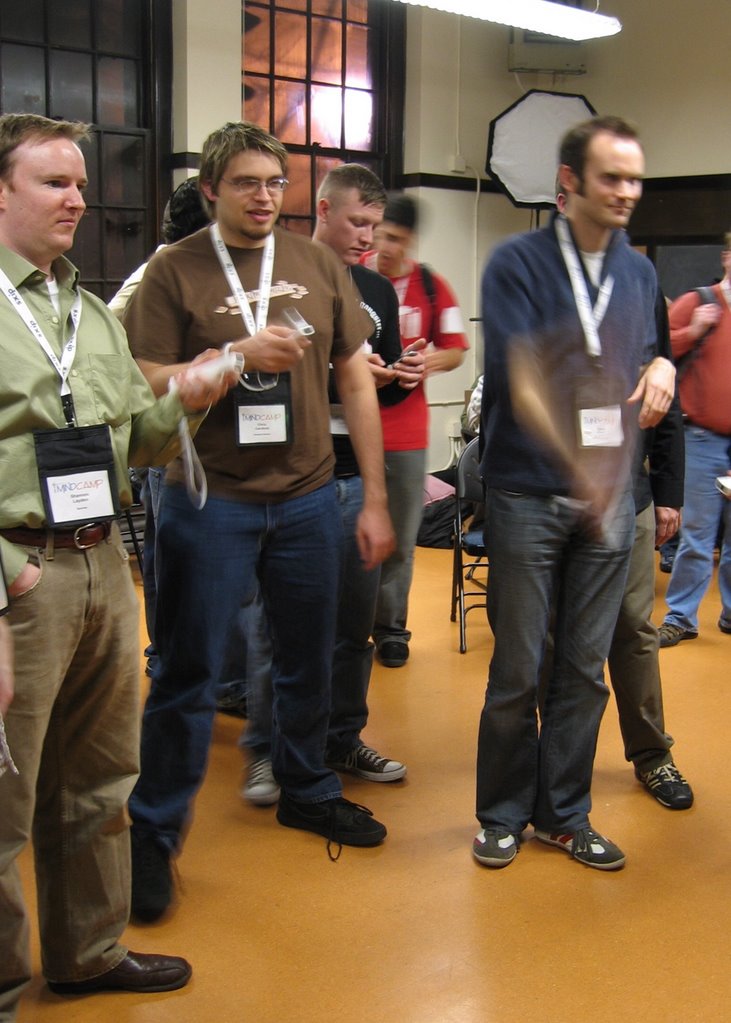
One of the highlights of Mind Camp was the "paper airplane" exercise Thomas Schmitz used in his session on generating new ideas. Each person took letter-size sheet of paper, wrote down a product idea, turned the sheet into a paper airplane, and sailed the plane across the room. The person who retrieved the plane opened it, built on the idea (sometimes using methods Schmitz had covered earlier), and sent it flying across the room again. The exercise ended when the fourth person added his or her idea. Then we went around the room, with each person reading the four ideas they were holding, and then saying a few words about his or her own techniques for getting new ideas and inspiration.
One participant, who identified himself as an educational consultant, said he finds the best way to get inspired and creative is to attend conferences in fields unrelated to his own. This makes perfect sense to me, but I had to wonder how many employers, even those who give lip service to creativity and new ideas, would even consider paying for it.
Would yours?
Turns out there was an undercover videographer at Mind Camp 3.0 who has taken her shocking discoveries public. Now the whole world will know what we were really up to.
The two-day Mind Camp has a trajectory similar to what I've experienced at dance camp weekends: Initial energy, meeting lots of people, a great session, a mediocre session where your energy slips, a chance hallway meeting of a fascinating group, a boring discussion with someone you can't get away from, a collaborative problem solving experience that deepens a friendship, exhaustion, the temptation to leave, a surprising encounter that leads you to new discoveries about yourself, sleep (not enough), wondering why you are still here (at breakfast), hanging out and realizing there are yet more fascinating people you haven't heard yet, cleaning up, driving home wondering why you are full of energy after 5 hours of sleep on a yoga mat and sleeping bag, being happy to see everyone at home, and wondering why the only thing that has changed is...you.
Three words: Great Mind Camp
Wi-fi, 200-plus geeks...this is a group supremely confident of their abilities to solve any problems. So not much energy is expended on averting problems, and there's no worry at all when the inevitable problems occur.
Solving problems is a good way to meet people. For instance, the yoga session I proposed turned into a mashup of trailer park yoga, traditional yoga, Qui-Gong, and back stretching!
Mind Camp 3.0 is this weekend, and I'm getting to know some of the participants through the planning process. One is Scott Berkun, whose eponymous blog contains an incisive analysis of bullshit. It starts with the history (beginning with Genesis, in which, Berkun points out "nearly everyone lied") and then goes into the nitty gritty of how to combat BS. Very much worth reading if you deal with human beings on a regular basis. Not sure I could use the suggestions to stand up to God, though, if he told me the apples were fatal.
After reading this essay, I'm very much looking forward to meeting Scott. As a writer/editor, my fight against BS is usually conducted from the inside -- for instance, someone has hired me to help them foist (wittingly or unwittingly) a certain amount of BS onto an audience. My job is to lower the BS quotient to the point that their communication won't be perceived as BS and discounted or (worse) sprayed back at them. Amazingly, bullshitters never seem to perceive this is a risk; they never say "Gee, Karen, I know this sounds like, er, bullshit...is there any way to make it sound more credible?"
 Think back on the day you got the greatest job, or contract, of your career. Chances are you sent in a resume, or wrote a proposal, that led to an interview, that led to the work. Not only did someone's decision to hire you go on to change your life, it changed some other lives as well -- those of the people who competed against you and didn't get the gig.
Recently I had dinner with a friend who does some of the hiring for his office. He'd been interviewing candidates, all of them well qualified, and two of them had been quite out of the ordinary. After some deliberation, he'd decided on one, but was still wondering if he'd made the right choice. He described his interactions with them in some detail. One of them had come across very thoughtful and thorough, but a tad hesitant. The other had been decisive, but verging on brash. In fact, another interviewer had complained about her manners. My friend had decided on the more aggressive candidate, saying her style was a good match for their particular field of work.
But just before he had to report his decision to the company's HR folks, my friend found himself having second thoughts. He sent the two finalists' resumes, along with the resume of a third highly qualified applicant, to his boss to get his opinion.
His boss pointed out that the two preferred candidates both had resumes and cover letters with multiple typos and spelling errors. The third candidate's written presentation was perfectly proofed. My friend and his boss discussed it, and agreed that because a major part of the job entails highly accurate and professional written communication with outside agencies, the candidate with the most professional writing and presentation skills would be the best one. They hired him.
A sobering story. I think I'll be a little slower to hit the Send button for the next few days.
The science blog Cognitive Daily reports on research into why people remember pictures better than words -- and how speaking the words aloud can change that dynamic.
A few days ago I received a check for my work on a project, which is not unusual. What made this check special was that it was marked "royalties."
Royalties?
Royalities are fees paid to a license holder of intellectual property for its use. For instance, when you buy a book, you make a payment that goes to the publisher, who (depending on the arrangement with the writer) shares or dispenses royalties to the writer or writers. The "royal" connection is historical: Rights to sell minerals were once granted by kings or queens to individuals or companies.
Royalities have become extremely complicated; they are dispensed based on complex agreeements, contracts, and licenses. An artist can sell his or her rights to intellectual property, and can also leave such rights to someone else via a will. Author Neil Gaiman worked with an attorney to develop a boilerplate will for authors' literary estates and has made it available to fellow writers as a free download.
My concern about a creating a special will for a literary estate would be how it would fit with an existing will covering an author's tangible property. But, as Gaiman points out, it's much better to have something on record than to leave people guessing.
I hope I'll get to worry about this some day!
If I feel myself getting too serious about the importance of writing, I'll watch Copy Goes Here, a short film by the Chicago design firm Coudal Partners.
NaNoWriMo (National Novel Writing Month) started promptly over here last night as I devoted my most productive work hours (1o p.m. to midnight) to hammering away at The Grave View (the working title of my New England mystery).
Meanwhile, a previous NaNoWriMo participant and some friends have launched GloRoMo, Global Rope Month. They will track (and reward) participants' efforts to tie 50,000 feet of rope during the month of November. (By "tying rope," they mean rope with people in it, as in bondage.) The organizers estimate a successful GloRoMo will involve tying and suspending eight people a day.
Perhaps there is room for a collaboration here? I'm sure by the last week of November some of the frenzied writers will be looking for rope, or perhaps for a good excuse -- like "I was helping a friend and got sort of...tied up."
One of the ways I earn a living is by writing content that keeps my clients' websites fresh. Sites with fresh content rank higher in searches, and consequently get more business.
This post from the Internet Marketing Blog explains how it all works from the business end. ("SEO" or "search engine optimization" is marketing-talk for making a website rank high in web keyword search results.)
Precious few.
Today, journalists write books, then they market them, and they become self-interested business people. They blog, and they become self-promoters on behalf of their blogs.
This is not their fault, either. The protective wall that (some) publishers (sometimes) have built to protect journalistic integrity within traditional publications turns out to have been much an illusion. And, as a former journalist, I can say that it was selectively rotted in some places all along, with calls to kill, slant, or emphasize coverage coming from the publisher's office, usually after a call from one of his or her country club cronies.
Consider this: The traditional news media has traditionally squelched its own reporters' attempts to cover news unpleasant to big advertisers (from the rise of the Internet, to global warming, to food contamination caused by agribusiness practices) for as long as possible.
Why am I ranting about this?
Jim Benson (J. LeRoy's Evolving Web) is one of several pundits making a fuss about TechCrunch, a site founder Michael Arrington frankly describes as "different." Arrington goes on to say:
TechCrunch is all about insider information and conflicts of interest. The only way I get access to the information I do is because these entrepreneurs and venture capitalists are my friends. I genuinely like these people and want them to succeed, and they know it and therefore trust me more than they trust traditional press."
Michael Arrington is a commentator. He is not a journalist. As a commentator, he can write about what he wants, when he wants, and how he wants.
Michael Arrington is my favorite kool-aide drinker. I wouldn't trade him for a box of Steve Jobses. But he is biased, he does answer to what is foremost on his plate, and he blogs accordingly. When I say biased, I don't mean he lies or distorts - but I do mean that he has a definite focus and that focus impacts what he writes.
On the occasion of Nevada Day, Geoff Duncan's Percolating blog pays tribute to his 6th and 7th grade teacher, Mr. Gandalfo, who made state history unforgettable:
He once marched a class of us through seven feet of snow into a meadow in the Sierras; when we got to the middle, he stopped, turned, and said to the exhausted kids, "So that wasn't easy, was it? When the Donner Party was in this field, the snow was twenty-two feet high. Think about that." I still do, Mr. G.