Please click the link at left to visit the new home of Writer Way at WriterWay.com.

Sunday, November 19, 2006

Hello? Hello? We're losing that mind-body connection

Yesterday's New York Times had a mindboggling article about a New York area fitness club that revoked a man's membership because he was making a grunting sound while lifting weights. He was bench pressing 500 pounds at the time, bless his soul.

If this were the independent action of a particularly fussy club manager, it would be one thing, but the "grunt-and-you're-out" rule is a policy of the club's parent chain, Planet Fitness -- a company whose management would, indeed, seem to be from outer space.

This article caught my interest because I'm currently doing a "trailer park" yoga program four days a week. It mixes yoga with weightlifting, jumping rope, running stairs, working with wrist and ankle weights, and working with heavier weights, including 15-pound handweights and a weight bench. I haven't heard anyone in our group of two dozen women grunt, per se, but I have heard plenty of moaning, shrieking, and screaming. And maybe a howl or two. The teacher, who is the most inspiring fitness instructor I've ever encountered, encourages the sound effects.

I tend to shriek, myself. Fifty leg lifts hurt.

According to the Times article, the club's no-grunt rule (and a few other weird ones, as well) has nothing to do with cutting down on distracting noise in the gym. It's based on the chain's philosophy that most members are intimidated and discouraged by body builders and other serious fitness types. The club therefore has crafted rules that discourage those fitniks from patronizing the gym and disturbing the place with sounds of physical effort.

Oh, heaven forbid anyone should connect hard work, physical or mental, with achievement. Americans are fervent believers in overnight weight loss, cosmetic surgery, and unregulated herbal potions. Hard work and discipline? Argggh! Fortunately Planet Fitness is here to protect us from the sight -- and sound -- of it.


Thursday, November 16, 2006

Photoblogging


While podcasting leaves me cold, I'm increasingly enthusiastic about photoblogging. Doug Plummer's Daily photo can be breathtaking, and I'm a big fan of New York's The Sartorialist. If you have time, the extensive reader comments at The Sartorialist can be as entertaining as the photos themselves. (So few blogs have really good comments that this success is worth some analysis.)

Seattle now has its own version of The Sartorialist, Pike/Pine, which, despite its name, has recently focused on Ballard -- and on fashion worn by 20-somethings. Yawn. Nice photography, but let's have some context here...fashion wasn't invented 10 years ago. Even Seattle knew about it before then. Let's see some of the older fashionistas who frequent Nordstrom designer shoes downtown.

Finally, you don't have to be a photo pro to make great use of pix to spice up a blog. Guy Kawasaki's blog uses small photos, often stock, usually to very good effect.

Wednesday, November 15, 2006

One last note from Mind Camp

One of the highlights of Mind Camp was the "paper airplane" exercise Thomas Schmitz used in his session on generating new ideas. Each person took letter-size sheet of paper, wrote down a product idea, turned the sheet into a paper airplane, and sailed the plane across the room. The person who retrieved the plane opened it, built on the idea (sometimes using methods Schmitz had covered earlier), and sent it flying across the room again. The exercise ended when the fourth person added his or her idea. Then we went around the room, with each person reading the four ideas they were holding, and then saying a few words about his or her own techniques for getting new ideas and inspiration.

One participant, who identified himself as an educational consultant, said he finds the best way to get inspired and creative is to attend conferences in fields unrelated to his own. This makes perfect sense to me, but I had to wonder how many employers, even those who give lip service to creativity and new ideas, would even consider paying for it.

Would yours?

Monday, November 13, 2006

Mind Camp video

Turns out there was an undercover videographer at Mind Camp 3.0 who has taken her shocking discoveries public. Now the whole world will know what we were really up to.

Sunday, November 12, 2006

Home from Mind Camp

The two-day Mind Camp has a trajectory similar to what I've experienced at dance camp weekends: Initial energy, meeting lots of people, a great session, a mediocre session where your energy slips, a chance hallway meeting of a fascinating group, a boring discussion with someone you can't get away from, a collaborative problem solving experience that deepens a friendship, exhaustion, the temptation to leave, a surprising encounter that leads you to new discoveries about yourself, sleep (not enough), wondering why you are still here (at breakfast), hanging out and realizing there are yet more fascinating people you haven't heard yet, cleaning up, driving home wondering why you are full of energy after 5 hours of sleep on a yoga mat and sleeping bag, being happy to see everyone at home, and wondering why the only thing that has changed is...you.

Three words: Great Mind Camp

Saturday, November 11, 2006

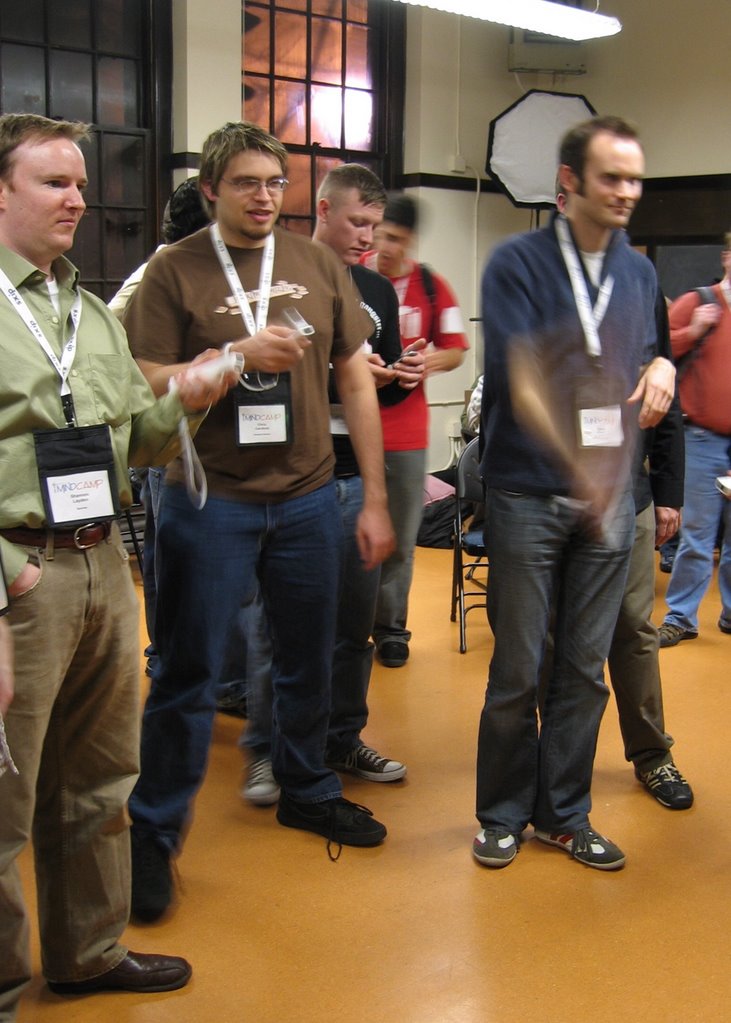
Mind Camp, 7 p.m.

Nintendo is here with new game to try out:

Mind Camp, 4 p.m.

Wi-fi, 200-plus geeks...this is a group supremely confident of their abilities to solve any problems. So not much energy is expended on averting problems, and there's no worry at all when the inevitable problems occur.

Solving problems is a good way to meet people. For instance, the yoga session I proposed turned into a mashup of trailer park yoga, traditional yoga, Qui-Gong, and back stretching!

Thursday, November 9, 2006

Bullshit detection

Mind Camp 3.0 is this weekend, and I'm getting to know some of the participants through the planning process. One is Scott Berkun, whose eponymous blog contains an incisive analysis of bullshit. It starts with the history (beginning with Genesis, in which, Berkun points out "nearly everyone lied") and then goes into the nitty gritty of how to combat BS. Very much worth reading if you deal with human beings on a regular basis. Not sure I could use the suggestions to stand up to God, though, if he told me the apples were fatal.

After reading this essay, I'm very much looking forward to meeting Scott. As a writer/editor, my fight against BS is usually conducted from the inside -- for instance, someone has hired me to help them foist (wittingly or unwittingly) a certain amount of BS onto an audience. My job is to lower the BS quotient to the point that their communication won't be perceived as BS and discounted or (worse) sprayed back at them. Amazingly, bullshitters never seem to perceive this is a risk; they never say "Gee, Karen, I know this sounds like, er, bullshit...is there any way to make it sound more credible?"